
When one imagines Scotland’s lochs and their folklore, the first thing that comes to mind is the Loch Ness Monster. However, long before the dawn of cryptozoology and anecdotes of a plesiosaur in the highlands, the lochs were purportedly inhabited by something entirely different.
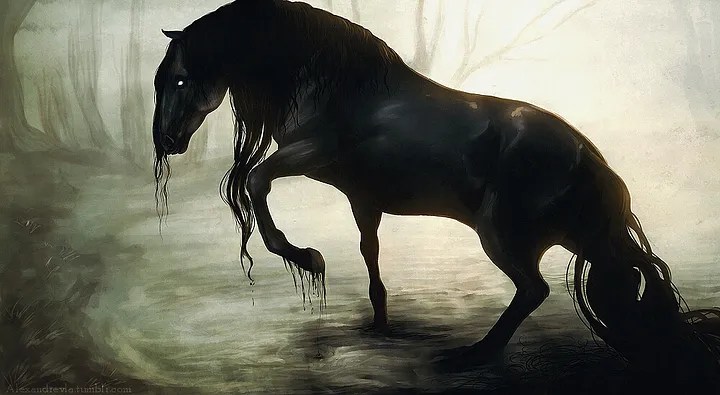
Scottish fairy stories speak of the Each Uisge, a shape-shifting fairy horse known for its equal beauty and danger. The very idea of it is striking: a sleek, grey horse emerging from the water, only to transform into a handsome man with water-weed hair and make its way towards the nearest village.
In Scottish Gaelic, “Each Uisge” translates literally to “water horse”. Informed readers may note a number of similarities to the kelpie; the key point of differentiation is that the kelpie inhabits running water, specifically rivers, while the each uisge is found exclusively in lochs.
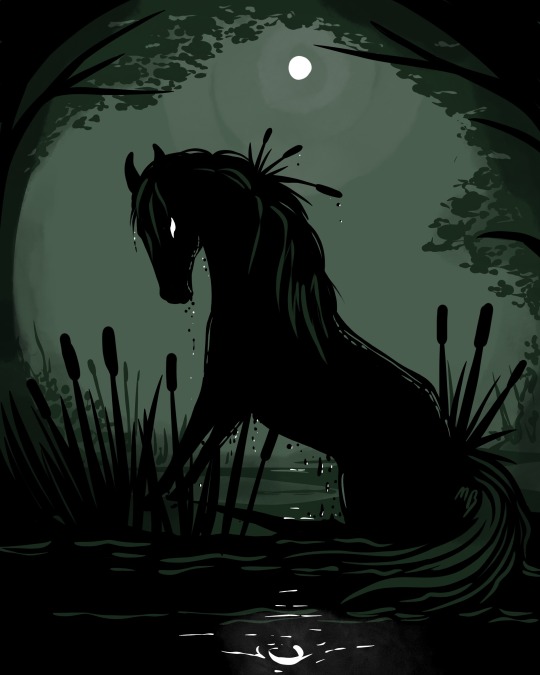
Image Credit: @DoodleBethel / Tumblr and Instagram
Like many folk fairy tales, the Each Uisge is a distinctly grisly legend. Whatever form the creature takes, whether man, horse or, in some tales, bird, it did so with the goal of finding unsuspecting prey and dragging them back to its home beneath the water.
As a horse, the Each Uisge would mingle with regular herds. When humans approached to capture them, the Each Uisge would allow itself to be caught and ridden. Once the rider was on its back, however, they would quickly find themselves stuck, and helplessly taken back to the water to their demise.
One popular story describes the creature luring a group of small children to mount it, its back elongating with every addition to capture as many of them as possible. In other stories, the creature would use its human form to attract young women as its victims.
Young Scottish women were urged to check any suitor’s feet and hair; the Each Uisge would retain its hooves in every form, and its hair would be filled with sand or water-weed. Those who fell victim to the each uisge would be devoured entirely, aside from their livers, which the creature was unable to digest. Their entrails would wash ashore days after their demise as the only evidence of their fate.
Despite its violence, the Each Uisge was not regarded as entirely without virtue. If one could restrain the creature without mounting it, adorning it cow shackles would fully subdue it, allowing for farmers to work the each uisge as though it were a regular horse. If the shackle was removed, the Each Uisge would immediately escape, often dragging its captor with it as penance.
Of course, the opposite was also said to have occurred: people losing their loved ones to the each uisge and subsequently seeking revenge on it. In such cases, the beast would be lured out of the loch to dry land, where it was more vulnerable. Like many faries, the Each Uisge was known to be particularly vulnerable to iron, and as such iron tools were considered ideal for dealing with the creature.
In the days following its death, it was known that instead of a normal carcass, the each uisge would dissolve into “star-shine”; a jelly-like material sometimes found on the banks of bodies of water. In modern parlance, this is considered to be the remains of jellyfish, but traditional Scottish folklore considered it to be a sign of fairy activity.
Like much folklore, the popularity of the Each Uisge has waned significantly in recent centuries. In 1900, John Gregorson Campbell wrote that belief in the creature was “generally a thing of the past”. That being said, the Each Uisge has still had some influence on modern popular culture.
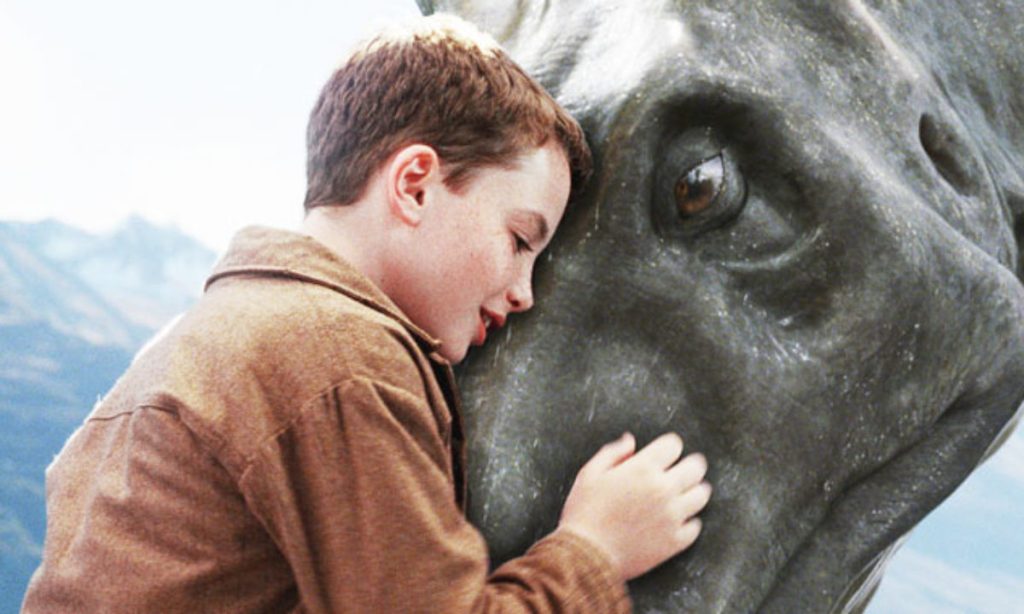
Image Credit: The Water Horse: Legends of the Deep (2007), Columbia Pictures.
The 2007 fantasy movie The Water Horse: Legend of the Deep was heavily inspired by legends like the each uisge and the kelpie, though it omitted many of their details, most notably their ability to shape-shift.
Though the legend of the Each Uisge is now relegated to niche interest, its felt presence undeniably influenced the landscape of Scottish folk like for centuries. If ever you find yourself on the banks of a loch, be sure to keep a close eye out for something stirring in the water.
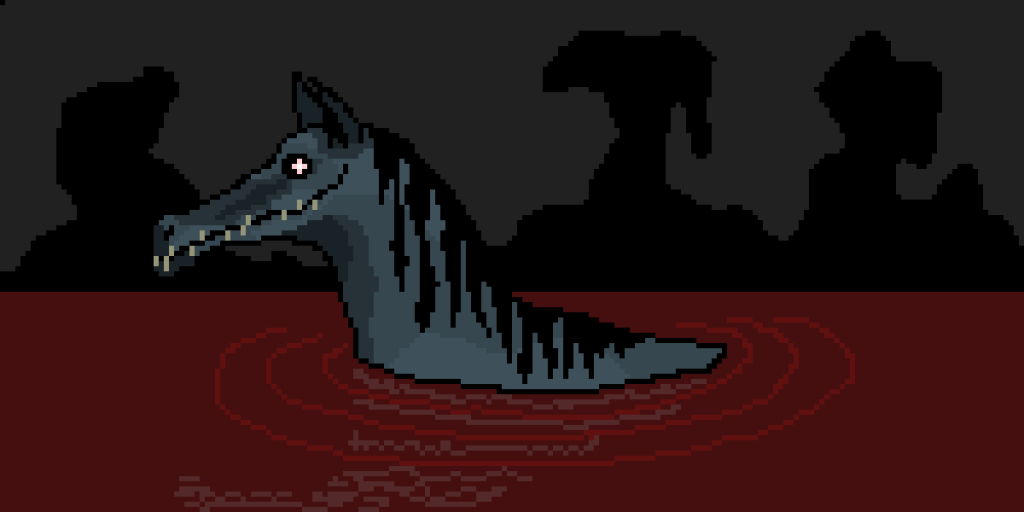
Featured Image Credit: PixilArt (@Not-A-Plant)





 The Mourning Paper