
Have you ever wanted to join a cult?
With a little luck and the eye of a crow, you too can learn what I discovered after summoning the creators behind the up-and-coming exhibition CULT.
Curators Philippa Tomlin and Gerard Torbitt, along with one of their artists, Cameron Clark, joined me to present an in-depth perspective on what CULT is and its purpose within the art community.
Rest assured, no one made me sign a contract with my own blood to get this interview, though that doesn’t explain why I’ve been chanting CULT in my sleep since speaking with these artists.
Before diving into the exhibition itself, I asked everyone if they could tell me a little about themselves.
Philippa chose to start us off by saying, “My name is Phil, I’m a painter. I paint dead things.”
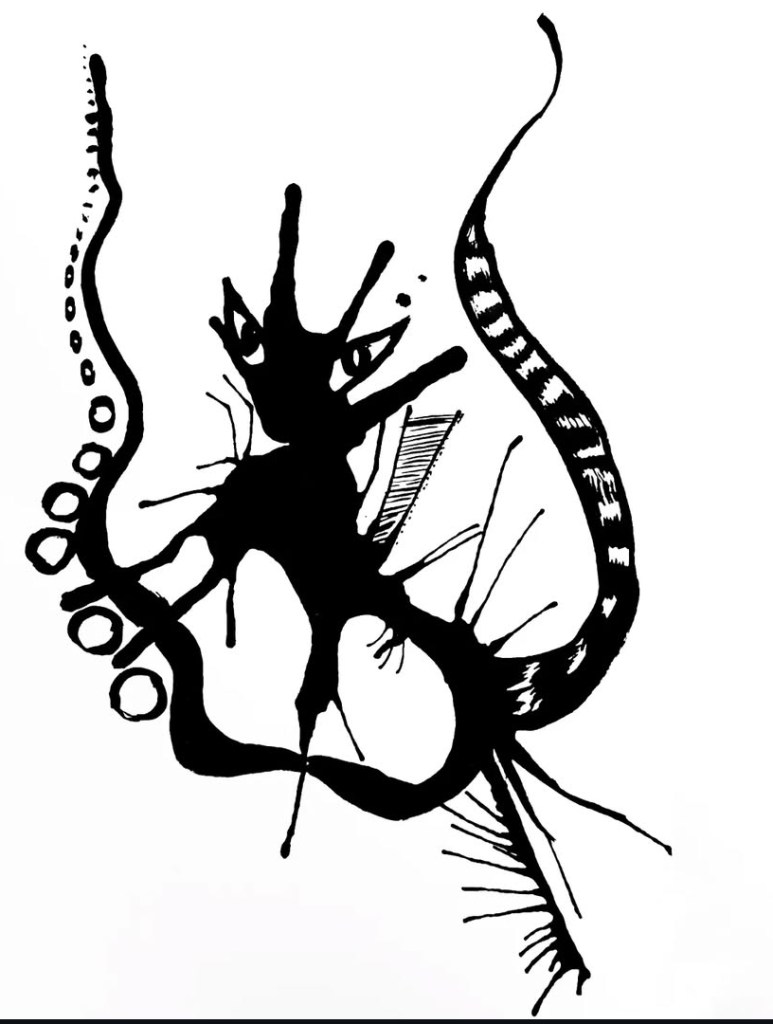
Artwork Credit: Phillipa Tomlin
I appreciated her straightforwardness and sincerely hope I don’t find a portrait of myself in her gallery anytime soon. Phil has a background in community arts as well as theatre. She primarily paints with acrylics and spray paint, dabbling between using canvases and large walls for murals.
Phil paints with a strong belief that there should be a better way of dealing with the subject of end-of-life, “It’s important to have a conversation about death, we don’t do that enough as humans anymore.”
Gerard introduced himself as an artist from Belfast whose art is chaos-borne. “It’s hard to talk about it without sounding pedantic – a wee bit woooo,” he said, expressing that his work was a creative outlet for his own struggles with mental health.
After speaking to a psychologist about the connection between art and psychology, Gerard learned that most of the symbolism within his art had been an encapsulation of his subconscious and all that he’d been dealing with – it was then that he felt he had a responsibility.
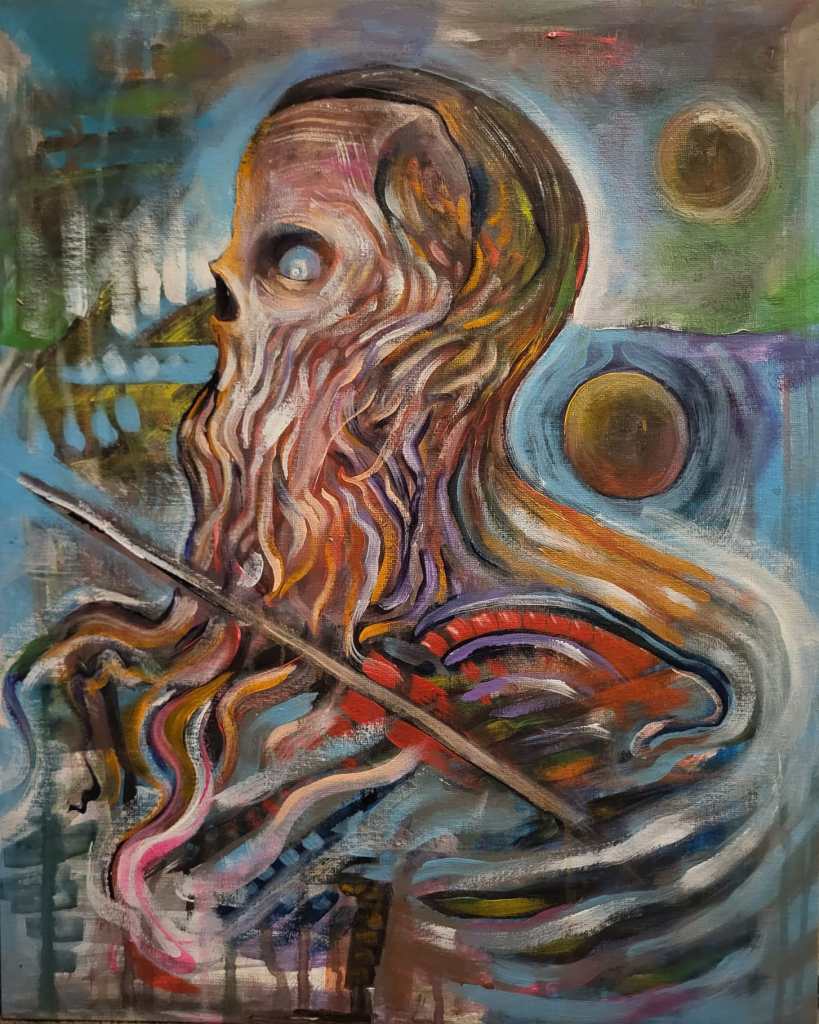
Artwork Credit: Gerard Torbitt
Working with acrylic allows him to make his art deliberately vulgar in a manner that can provoke reactions and draw emotions from those who might feel prompted to talk about it.
Cameron spoke last, stating he was a mixed-media artist who creates 3D art. “I like the weird and the wonderful,” he said, expanding on the idea that his artwork focuses on the macabre alongside darker elements he enjoys and finds inspiration in.
Originally, Cameron left school to pursue silversmithing and jewellery design, where he quickly learned that he loved being able to take something simple and build shape and dimension into it. Cameron also opened up about his journey with mental health, something he only came to terms with in his 40s, when he recognised his trauma had been materialising as night terrors.
“It’s exciting because we don’t know about it. Why are we so afraid of death? No one is immortal.”, Cameron stated.
He wants his art to provoke reactions where people think, ‘That’s weird, I want to touch that.’ He wants there to be a soul in what he creates, something so visceral that others can’t prevent their morbid curiosity from wanting to look further.
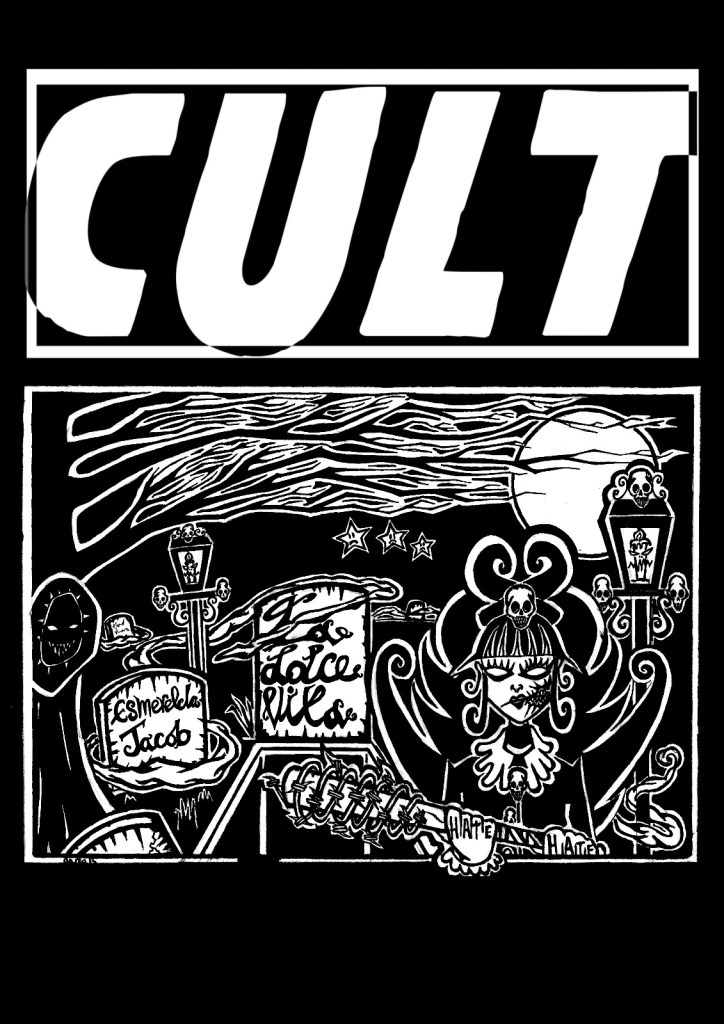
Artwork Credit: Darseuax Grimm
“It’s why we enjoy making art – like watching a giant seagull ram a magpie.”
The three went on to discuss their reasoning behind the name for the exhibition, which was truly simpler than I had expected.
“The joke is that it’s like – is this some form of cult?” Gerard told me, explaining that it hadn’t been their initial intention to stay with the name, but that it quickly became a staple of what they were hoping to achieve.
“You don’t wanna join a cult with someone who’s pretending it’s not a cult.” He said, presenting logic I couldn’t argue with.
CULT is exactly as it reads on the tin, it indulges those seeking to create something without the obligation of making it suitable for every audience. The type of art that gets stuck in your throat when you try to swallow it, and yet, you can’t help yourself from going in for more.
“Basic page 3, dark art psychology,” Gerard had said, delving into how the image of CULT doesn’t necessarily fit any specific criteria, but there’s a complexity to it you won’t find anywhere else.
“It seems to be this kind of creative space we exist in where other artists don’t bother, our own wee playground.”
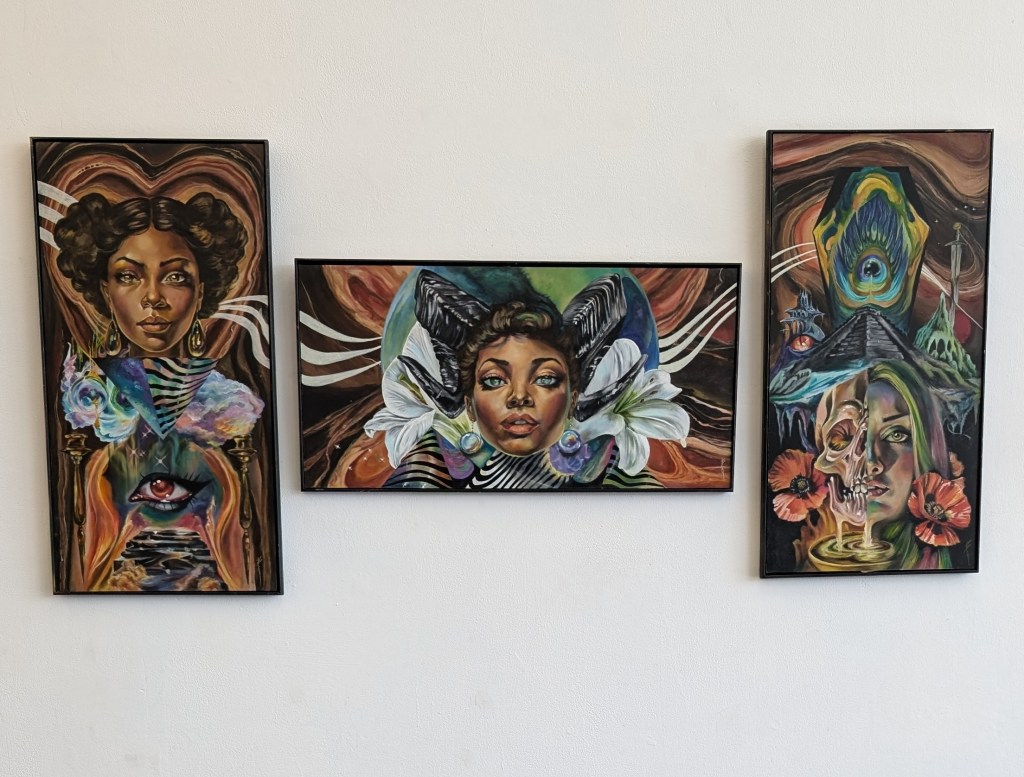
Artwork Credit: Lakisha McQuany
It all started with Gerard creating a group for artists on Instagram, eventually managing to get Phil to join before they set out on a mission to find people who were serious about taking the project into the real world. Not everyone joined because they were afraid, cautious of taking the next step from online to real.
CULT wants to be different, with artists being present, selling and sharing their philosophy as well as their product.
Phil said, “I wanted everyone to, if they wanted to, level up. I met people from fan art, markets, and purely existing online. I would say that while the art wasn’t curated, the artists were.”
South Block, Glasgow, was the first location where CULT manifested. By design, CULT wanted at least half from Scotland, some more Irish artists, an equal mix of genders as well as some queer representation. They love to be as diverse as they can be, not just via the artists but the art forms too.
“CULT seemed like a silly idea. You know when you get ideas and then suddenly you’re like – oh, we’re doing this?” Gerard had exclaimed.
“I couldn’t believe it when everyone just turned up.” Phil followed.
There were frustrations, of course, but not once did they get discouraged.
The second location CULT featured was in Braehead. Although progress had been made on the exhibition itself, they felt as though they weren’t able to achieve what they’d set out to do, whilst also enduring some unfortunate difficulties, such as the people involved not cooperating fairly within the space, as well as others not showing up.
Despite this, the footfall for CULT’s second feature was huge, at least three times bigger than what they’d gotten in the art space.
Phil said, “It wasn’t just artsy people, it was families, people coming in excited to go to the cinema. It was real people looking at our art.”
CULT caters to everyone willing to accept that not all art is pleasant to consume. Sometimes it prompts reactions within you that you might not want to acknowledge – that’s perfectly okay, no one’s forcing you to view it.
But if you are the type of person who finds comfort in the disturbed, then this is for you.
“There is a place for CULT. People do want to see the macabre, they wanna see the weird, they wanna see the grotesque, they wanna see things that are relevant that people are not talking about.”, said Cameron Clark.
CULT has an uncensored nature to it, and it welcomes you to explore that.
Gerard talked about a piece of art he’d produced before, something that was deliberately unsettling to look at and yet, a person still bought it.
“It sold because someone had noticed something about the morbid baby-likeness of it that reminded them of a trauma they’d had, and the vulgarness of it spoke to them; it was darkly comical.”
Cameron jars up his night terrors and 3D sculptures, before locking them away with a protective seal as a way to deal with his trauma, before allowing people to purchase them.
“Here, buy it, you can do the same thing for yourself. It’s like chaos magic – you deal with life and what it gives you. They can hold it, put it on a shelf. They can take control of it.”, he stated.
It’s often said that artists struggle, but people don’t truly process how common an obstacle it is.
CULT exists for this purpose – to serve those who don’t have the support. It’s individuals who are married and have kids, the ones who work full-time jobs, the ones like Cameron who didn’t get the chance to explore his craft until later in life.
“I’m in my late 40s, and it’s only now that I’m coming into my art properly because I did exactly what I was told to do, I did exactly what I was expected to do, and none of it worked. I’ve gotten to the age where I’m like – but I want to play with dragons! I wanna make vampire pictures, I wanna do this – and there is not a sod to stop me.”
Cameron believes there’s not enough discussion being held about the subjects CULT seeks to unravel, themes like sex, politics, death, and religion, as though these topics are mere broken bones that everyone’s chosen to put a band-aid on and call it a day.
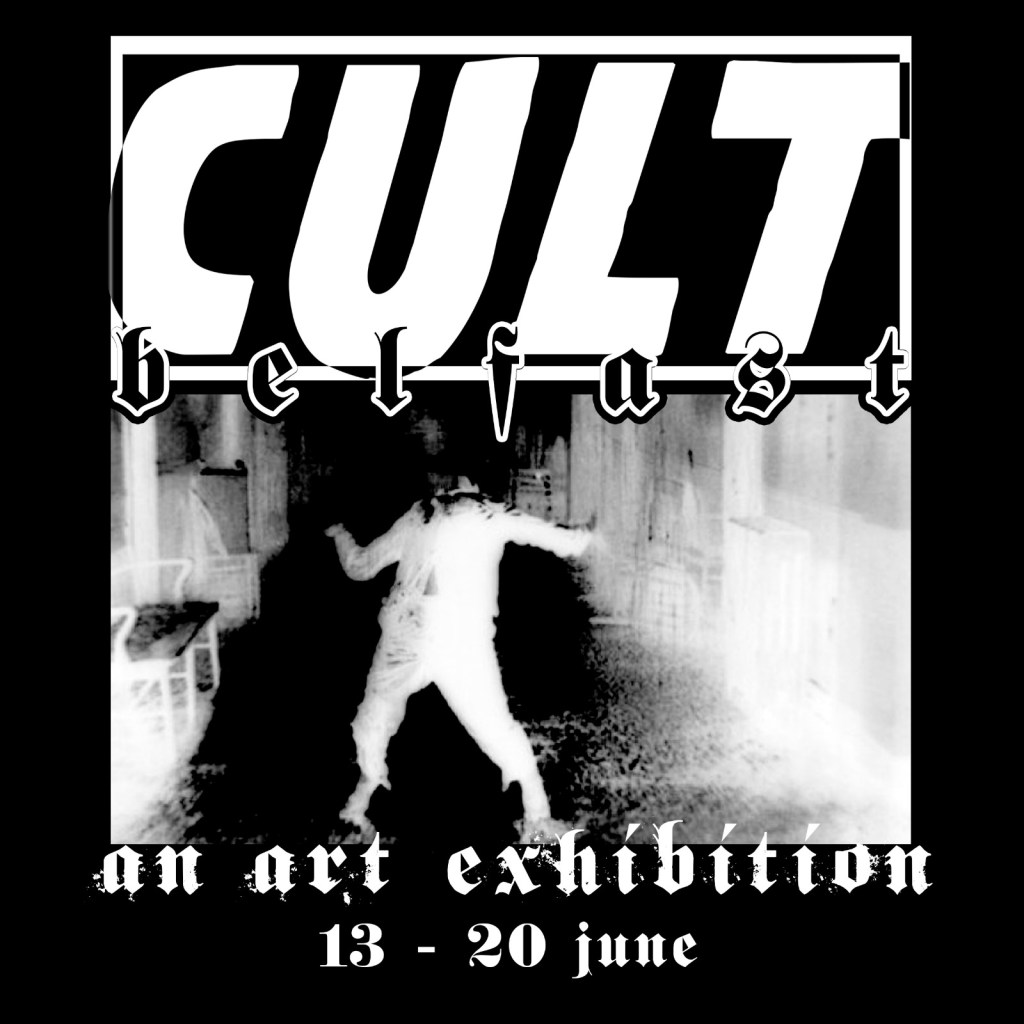
Image Credit: Cult Art Exhibition
He continued, “These are things that we need to be having honest dialogue about, not necessarily hate, it’s all about just talking and seeing where everyone’s coming from – bring it together and produce it for the world. This is what we’re doing.”
CULT currently hosts 13 members and is self-funded at the moment. Artists involved all pitch in a hanging fee for their art to be displayed, Gerard manages all the design work, whilst Philippa maintains the admin.
They have an ambition to eventually become a CIC, a Community Interest Company, that upholds a legal commitment to prioritise benefiting those it serves rather than the profits it produces.
If you’re interested in attending CULT, their next exhibition begins Friday, the 13th of June, at Vault Artist Studios, on Victoria St. in Belfast, described as “an exhibition of visceral artworks exploring the grotesque, ethereal and macabre through dream space, heightened reality and dark fantasy.”
From Saturday the 14th onwards to the 19th, there will be workshops available for participants which you can book online through Eventbrite and links featured within their Instagram bio – further information regarding the exhibition can be found there too.
You can also follow along through their Instagram, @cult_anartexhibiton.
Featured Image Credit: Cult Art Exhibition



 The Mourning Paper