The venue pulls me in with its electric blue glow, glass bricks mirroring the artwork of Drab Majesty’s 2017 album, The Demonstration, beneath cursive signage reading Ivory Blacks.
Situated in the middle of a busy Glasgow street, nestled between a hotel, bars and takeaways, the club stands out like hair highlighted under a strobe light. Friends congregate, arms folded, holding cherry-red cigarettes, exhaling smoke into the sky and catching up on the latest from the perpetually demoralising tea party that is life – I am struck with awe.

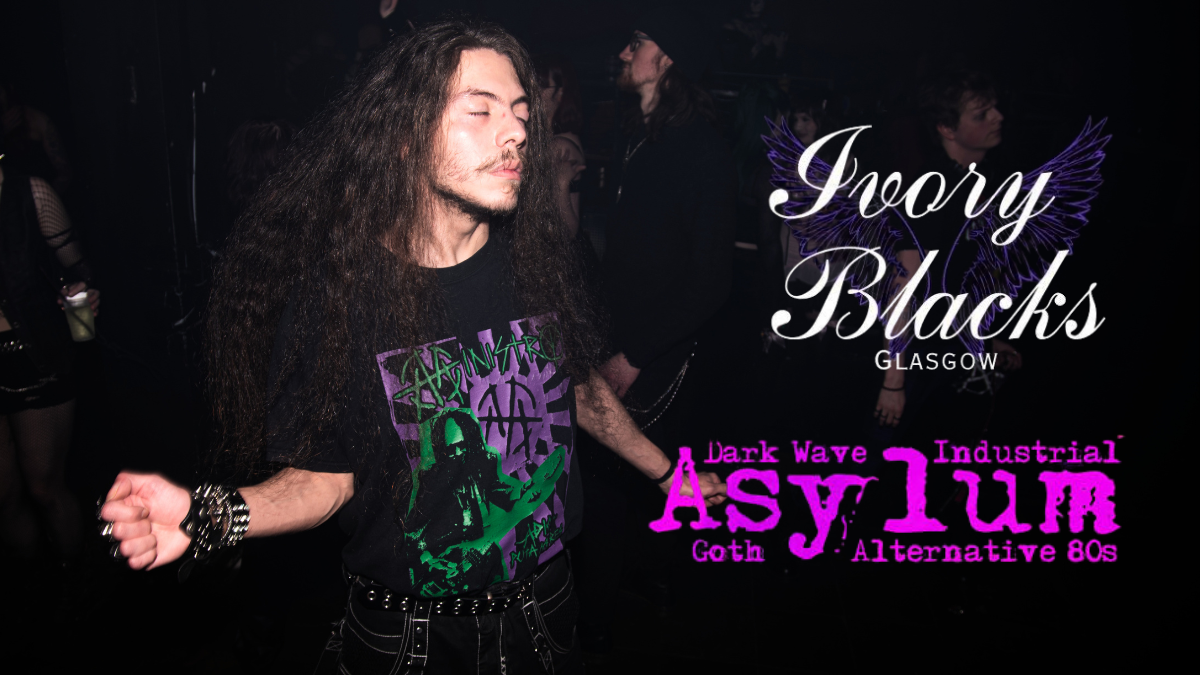
I finally discover what lies beyond those swinging black industrial doors: a dark dance floor, thick with fog, flooded with purple light and an opaque cloud creating an almost silvery haze. A chorus of bodies sways in time, synchronised, intimately present with the sound and with each other.
“Think stompy boots, glowing accents, shadowplay, and music that hits your bones as much as your ears.” — Ivory Blacks, Asylum

Spikes, fishnets, leather and lace; I get the sense that I am surrounded by an unapologetically individual energy. The bass from the electro-industrial music vibrates through my body as I traverse the space, observing clothing, social exchange, and raw, unedited posture.
There’s a seating area to the left of the venue, facing the bar. That is where I find myself immersed in the social scene – people leaning into one another, conversing, while others pass by me towards the dance floor. The veil of mystery lifts, and I proceed to establish a dialogue with the building.

I strike up a conversation with one group in particular, made up of five regulars at Asylum, a club night they describe as sacred ground. Being there with my camera draws curious looks: what is this about? Sharing my intent for being there is met with immediate, mutual understanding – this is a community built on acceptance – and the room feels different.
The dynamic shifts from casual conversation to active collaboration. Photographing becomes a personal act, translating authentic personality and reflecting what Ivory Blacks and Asylum are built on. Moving between scales of intimacy, letting the camera document the room, the request of “can I take your portrait?” feels like a camouflaged “I get you, you get me, we are friends now.”

For a quarter of a century, Asylum has been a staple of Glasgow’s alternative scene. Originally named Bedlam, with a residency at the Queen Margaret Student Union, to the regulars at my table, 25 years isn’t just an impressive milestone – it represents decades of continuity. Generations of goth and alternative music lovers have crossed this exact threshold, seeking the same solace beneath dark wave, synth and industrial beats.
The event is led by DJ Asylum (Brian Terry) and typically runs on the fourth Saturday of each month, featuring dark wave, industrial and 80s alternative tracks for a £5 entry fee.

The financial cost of a night out in Glasgow extends beyond the price of admission: drinks, hotels, post-club food and transport all add up. Places like Asylum preserve a more budget-friendly approach to clubbing, allowing for an easier escape from the daily grind and an accessible passage to dance.
Walking through Ivory Blacks’ doors on a Saturday night, you can expect a playlist of your favourite goth tunes, inclusivity and openness.

Including Asylum in my reports on parties, culture and music within Glasgow uncovered a close-knit community, and a group of friends that became family very quickly. Returning each month for material turned this report into something special: I found friends that I now consider very close to my heart.
As the final tracks play out and the house lights begin to lift, I pack away my gear. Pushing back through those heavy black industrial doors, the cool Glasgow night air hits immediately. The street outside is quiet now, the takeaway shops filling with customers, but the low-frequency rumble of the bass still hums in my chest.

On my way to the night bus, which shows up if you’re lucky, with my camera over my shoulder, I realise the true value of this project wasn’t just the frames captured on my sensor. Every person photographed in this series – the faces, the regulars, the dancers lost in fog – agreed to share a slice of their space with me. Many of those strangers behind the lens have now become dear friends.
In the end, that is exactly what Asylum is truly about: taking the outcasts, the night-walkers, and giving them a space where they aren’t just documented, but where they genuinely belong.
All Image Credits: Brendan Hughes