Scotland has always had its own form of Gothic consciousness, despite the genre generally thought of as Victorian English in origin.
Uniquely Scottish forms of the Gothic have often been deployed as a means of investigation into Scotland’s cultural identity. Robert Burns’ ‘Tam O’ Shanter‘ is one of Scotland’s most notable examples of a distinctly Gothic form of Scottish literature.
The 18th-century long-form poem structure plays right into one’s fear of a societal underbelly; Burns places a caricature of masculine Scottish identity named Tam at the forefront of the narrative. Tam is a working man and a farmer, but also prone to indulging in Scotland’s cultural excesses: tavern dwelling and alcohol.
Burns highlights the natural landscape of Scotland, featuring the idealised Scottish landscape that transmutes into something twisted and altered under the night sky.

Image Credit: Wikimedia Commons
Burns conjures images of: “The mosses, slaps and styles,” as well as Ayr, where Tam originates:
“Auld Ayr, whom ne’er a town surpasses,
For honest men and bonny lasses.”
Ayr is portrayed as an ostensibly Scottish town. By virtue of its proximity to an idyllic Scottish countryside, it is able to infuse goodness into its inhabitants.
We are introduced to Tam in a local tavern, which is described warmly:
“And ay the ale was growing better:
The landlady and Tam grew gracious,
Wi’ favours, secret, sweet, and precious.”
It is here that the moral component of the poem comes into play.
Within the inn, it is prophesied by Kirkton Jean that if Tam continues to succumb to his worst impulses, he will be found dead: “Deep drowned in Doon…catch’d wi warlocks in the murk.”
The warm setting of the tavern is an important fixture in the poem; Burns takes a familiar environment and corrupts it with the imagery of the uncanny and twisted sabbath.
Tam is forever changed by his encounter with the witches and the sabbath in the forest. As he watches from his secret place, he is struck by both desire and fear. Longing to join in but too afraid of the celebration of the devilish, non-human ‘other’ happening in front of him.

Image Credit: Wikimedia Commons
From this, it can be said that Tam O’ Shanter appeals to the reader’s socially constructed notions of what a cultural and national identity should look like.
In the book ‘Damage Land: New Scottish Gothic Fiction’, Alan Bassett makes the case that Burns had bridged the gap between the Gothic and Scottish fiction, and in doing this synthesised something novel in Tam O’ Shanter:
“The sabbath is uncanny given its supernatural nature in its mirroring of the inn; both are gatherings, places of ecstasy, and deal heavily with the immorally excessive.”
This mirroring reveals the blurry distinction between the witches of the forest sabbath and those who inhabit the tavern. They are only removed from each other by small degrees.
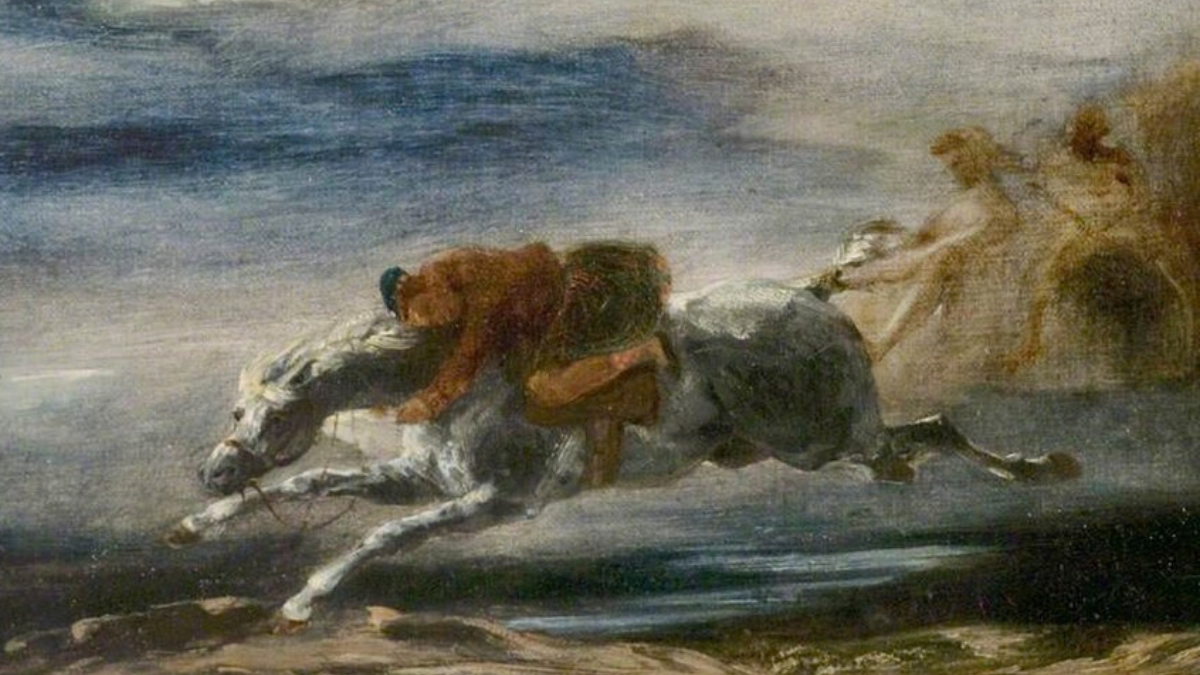
The narrative conclusion is ultimately that we, the reader, see masculinity defeated. Tam, who had been presented as a caricature of Scottish identity, almost comes clambering down to his death, saved solely by his companion horse.

Image Credit: Britannica
In James Hogg’s ‘The Private Memoirs and Confessions of a Justified Sinner’, we see the aforementioned morality tale play out once again. Hardline Calvinist Robert Wringham is the main character, and he finds himself wandering through life looking deeply into scripture for his identity.
The narrative begins in 1687, just before the 18th century had arrived. By its latter half,
Scotland was experiencing a stark crisis of consciousness regarding ethics and religion.
The country saw the rise of Protestantism, all the while loyalty had become divided between Scotland itself and a growing, imperial British state.
The story focuses heavily on the theme of the divided self. This is something that the Gothic has keen familiarity with, as this theme can also be seen in Dr Jekyll and Mr Hyde (written by Scottish author Robert Louis Stevenson).
In Scottish literature, we see this trope come up again in Alasdair Gray’s Lanark.
Just as Burns had done, Hogg too combines elements of Scottishness and the Gothic.

Image Credit: Scottish Poet Library
Here, the divided self is lamented through the inclusion of characters that represent the devil, portrayed through a folklorish lens. The devil can shapeshift into many forms in this story, and his true form is always ambiguous to the reader.
On the Calvinism featured within the book, Sheffield Gothic writes: “[t]here are several key theological distinctions within Calvinism, including the notion of Revelation, and the concept of Predestination. Calvinist doctrine divides all humans into the categories of the elect or the damned, and each identity is designated with a predetermined end.”
Religion as a central theme drives forward a two-pronged interrogation of morality and Scottish identity (as it was becoming intertwined with Protestantism). The book’s central confrontation with the ‘devilish’ side of one’s self and the underbelly of one’s own mind directly calls into question the value of rigid social determinism, as well as the concept of predestination.
Hogg makes it clear that he believes this form of determinism to be a social ill, as Robert says outright:
“We are all subjected to two distinct natures in the same person. I myself have suffered
grievously in that way.”
Moreover, as the uncanny once again rears its head in this text, it can be said that this resurfacing elucidates how religious institutionalism and societal ethics are treated as fragile by Hogg. This thought seems especially true given how ideologically partitioned Scotland was at the time.

In this sense, Hogg also treats both culture and society in a deeply cynical way.
This mirroring between good and evil, eventually revealing the lack of a hard distinction between them, is something that was also investigated within Tam O’ Shanter.
Hogg goes beyond the confines of a formulaic morality tale. His text directly confronts normative ethics and draws on this idea that strict social determinism is corrosive to flourishing.
Much more ironic than that of Burns, who boldly strips his character of his masculinity before sparing his life, the book underscores and questions the direction Scotland was heading in culturally and institutionally at the time.
In conclusion, Scotland has always had a close connection to Gothic literature. This literary connection has been propelled by figures like Robert Burns and James Hogg, who sought out the Gothic in order to deal with the anxiety surrounding Scotland’s ever-evolving cultural norms.
The divided self and the uncanny have cast a large shadow over Scottish storytelling at
large. No doubt, this type of storytelling will remain a prominent structure in the future.
Featured Image Credit: Wikimedia Commons / William Carse