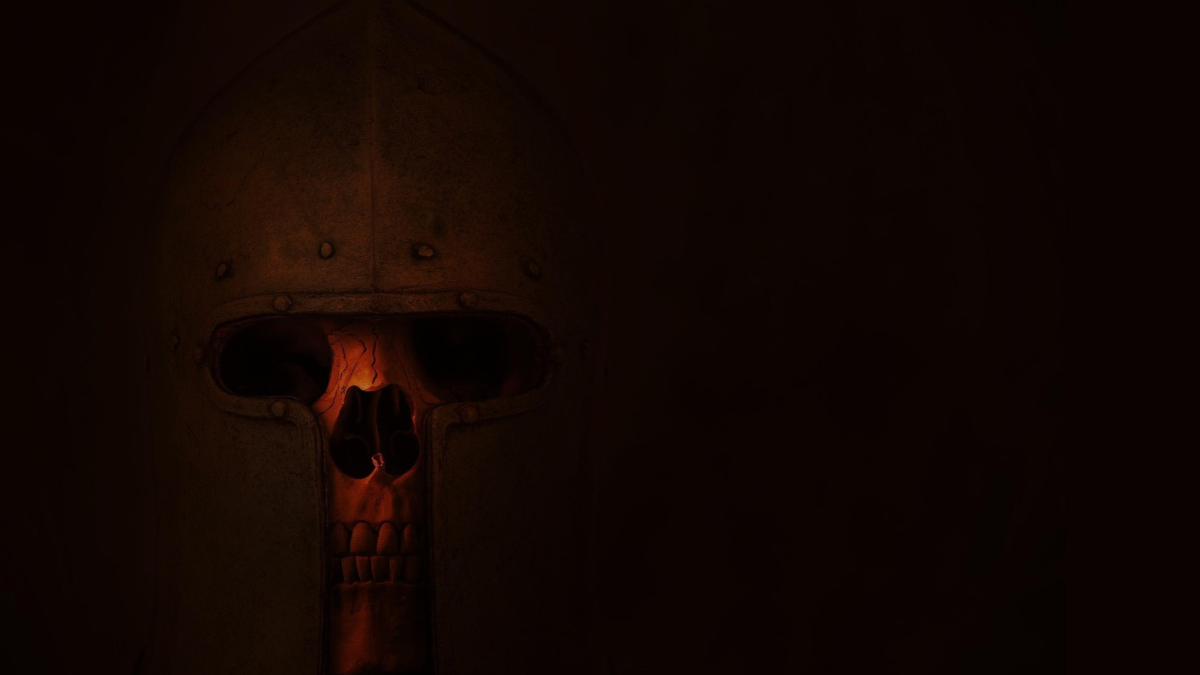
The year 2013 saw the emergence of an unusual meme, all stemming from a single tweet from user @dril: “if your grave doesn’t say ‘rest in peace’ on it you are automatically drafted into the skeleton war”. This tweet soon snowballed into wave upon wave of calls to join The Skeleton War, rising from its online grave every October.
It turns out that the ‘Skeleton Army’ concept is not limited to mid-2010’s Tumblr; it reaches back thousands of years. There are ancient influences such as a fear of revenants (the returning dead), though an interesting detail is that the mortal flesh usually stays on these undead characters, emphasising the idea of a corpse rising from its grave rather than a bare skeleton. This continues on into Medieval Europe, where famous artistic subjects such as The Three Living and The Three Dead depicted advanced decomposing corpses rather than bare bones. One of the earliest glimpses of a bona fide skeleton army is that of the 16th century painting ‘The Triumph of Death’ by Pieter Bruegel the Elder in c.1562 depicting a horde of undead skeletons making their way across the landscape, evoking the Apocalypse via war, pestilence, famine, and death. This is operating within two traditions: the Dance of Death and the Italian Triumph of Death, with the skeletons being Bruegel’s unique addition (echoing perhaps Hans Holbein’s famous Danse Macabre woodcut skeleton illustrations). The undead skeleton continued to morph and “accrue new meanings throughout the decades while retaining tacit indications of its cultural origin… ” (McCrea, 2026), from the classic memento mori to the ‘skeleton-in-the-trunk’ twist that features in many early Gothic novels, to the modern symbolic shortcut for death and evil that is both universal and culturally relative.

Featured Image Credit: Unsplash
Today, the Skeleton Army is most commonly recognised as a classic low-level villain for the hero of a fantasy adventure novel/film to battle, initially as a formidable foe before developing into a self-aware comedic minion. This pop culture depiction acts as the trope which my two primary texts are reinventing, introducing new ways of thinking about the very concept of the Skeleton Army as a faceless evil; “mindless foes to moral negotiators” (McCrea, 2026).
As I scrolled through numerous memes I started to recognise stills taken from some of my favourite childhood films: ‘Jason and the Argonauts’ (1963), ‘The Seventh Voyage of Sinbad’ (1958), ‘Evil Dead: Army of Darkness’ (1992), more modern films such as ‘Spy Kids 2’ (2002), ‘The Lord of the Rings: The Return of the King’ (2003), ‘Pirates of the Caribbean: The Curse of the Black Pearl’ (2003), ‘The Mummy 3: Tomb of the Dragon Emperor’ (2008), and a myriad of different skeletal enemies in video games such as ‘Minecraft’ (2011), the ‘Super Mario’ franchise (specifically 1990 with the first appearance of Dry Bones), and ‘Clash Royale’ (2016). The sheer quantity of different depictions of heavily armed undead skeletons in these memes begs the question; why is our culture overflowing with undead skeleton armies? What is it about these hordes of human remains that captures our imagination? The short answer might simply be they’re super scary skeletons, of course they’d be used as an enemy to fight against. They literally embody our fear of death. That may be the case, these skeletons do indeed send shivers down your spine, but I will argue that our relationship with this enduring figure, specifically the idea of a horde of unstoppable skeletal warriors, is more complex than simply death made manifest.

Image Credit: Europeana / Unsplash
Throughout my PhD on funerary rites in fantasy literature, I’ve spent a great deal of time researching what happens to bodies after death, how different cultures dispose of the dead, and how we choose to remember them. One book that had a particularly strong impact on me was Alexa Hagerty’s 2023 book Still Life with Bones. Hagerty describes how forensic anthropologists work to rescue human remains from forced anonymity after political murder, genocide, and other atrocities. By examining the bones, they can help restore the identities of the people who were killed and reunite them with the communities from which they were taken.
Hagerty sums up this work thus:“Forensic exhumation is practiced at the crossroads of two ways of thinking about the dead body: as a scientific object to be analysed for evidence of crimes against humanity, and as a subject, an individual, someone loved and mourned.” (Hagerty, 2023: p. xiv)
Reading this completely changed how I think about human remains. Bones are never just bones. They can tell stories, reveal crimes, restore identities, and reconnect people with communities that someone tried to erase. In that sense, the dead can still speak both to and against the living. This became the starting point for how I began thinking about Skeleton Armies. What happens if the bones themselves aren’t entirely passive? What if they still carry traces of the people they once belonged to? Looking at skeletons in this way turns them into more than spooky monsters or convenient fantasy enemies. They become a way of thinking about some very Gothic fears: death, identity, and whether we can ever completely lose control over who we are. As Thomas Laqueur reminds us in The Work of the Dead, the dead are not simply inert. They remain socially active even when all that is left is skin and bone (Laqueur, 2015).

Image Credit: Adam Zubek-Nizol/Vecteezy
I’m going to focus on two recent examples that take the familiar Skeleton Army and do something new with it. Both ask us to consider whether some part of the individual remains inside the skeleton, even when that skeleton is forced into a mindless crowd. The first is Tamsyn Muir’s The Locked Tomb series, particularly Gideon the Ninth from 2019. The second is the 2024 update to the core rules of Dungeons & Dragons and its treatment of undead skeletons. Both take one of our oldest and most recognisable symbols, the human skeleton, and use it to explore a very modern fear: losing our individuality in a world increasingly shaped by automation, control, and systems that value us mainly for what we can produce.
First things first, what exactly makes these undead skeletons Gothic? Aside from the obvious fact that they are literally undead skeletons, I think we can understand them through another classic Gothic figure: the automaton. An automaton is, in Minsoo Kang’s words, a “machine that mimics a living being” (Kang, 2011). Automata make us uncomfortable because they blur boundaries we would prefer to keep separate. Are they human or machine? Alive or dead? Real or artificial? We like to imagine that these categories are clear, but the automaton suggests that they might not be. That uncertainty creates what Kang calls an “undercurrent of uneasiness” (Kang, 2011). It is the same uneasiness that runs through the history of automata. These machines have been used as religious objects, scientific demonstrations, practical devices, and entertainment. They have represented divine order, shown off human ingenuity, and raised questions about what separates people from machines. At the centre of all this is an object that threatens to become a subject. It looks back at us, moves like us, and may even appear to think like us. If a machine can copy human life convincingly enough, what does that say about us? Could the machine somehow take our place? Worse still, could it reveal that we were more mechanical than we wanted to believe?
A resurrected skeleton can be seen as a particularly disturbing kind of automaton. Like a mechanical figure, it moves and performs tasks without having full control over its own actions. The difference is that it isn’t made from wood, metal, or plastic. It is built from the physical remains of an actual person. Usually, an automaton takes lifeless materials and gives them the appearance of life. The skeleton reverses that process and takes the remains of someone who was once alive and turns them into the material for a machine. That raises an obvious question: how much of the original person is still there?

Image Credit: The New York Public Library
There are two main reasons someone might create a Skeleton Army, and both depend on what the skeletons are expected to do. The first is conquest. This is the version we probably picture immediately: an unstoppable horde of sword-wielding skeletons chasing our heroes across a battlefield. These armies depend on sheer numbers. One skeleton might not be too threatening, but hundreds or thousands of them become a very different problem. They don’t need food, rest, medical care, or morale. They keep moving forward, and unless you happen to be the hero of the story, they can be extremely difficult to kill. In this version, the Skeleton Army exists to overwhelm and destroy. Local communities are killed, homes and possessions are burned, and the land itself is brought under the control of whoever commands the dead. This is conquest through destruction, fear, and complete submission. As Roger Luckhurst argues when discussing zombie hordes in Zombies: A Cultural History, individuality doesn’t really matter in these massed groups. What matters is scale. The bodies become a statistical threat: a huge, faceless crowd moving towards you (Luckhurst, 2015).
The second type is less common but perhaps even more disturbing: the Skeleton Army used for labour and resource extraction. Here, the word “army” doesn’t necessarily mean soldiers. Instead, it describes the enormous number of skeletons and the fact that they have all been forced to serve a powerful ruler. Their undead bodies make them valuable workers because they don’t need sleep, food, wages, or breaks. They can simply keep working. We see similar ideas in the zombie genre, particularly in films such as White Zombie from 1932 and The Plague of the Zombies from 1966. In both cases, undead labour is connected to histories of slavery, exploitation, and colonialism. The horror comes from seeing people stripped of their freedom and reduced to tools.
The world of The Locked Tomb is one in which death is built into the political and economic system. The Nine Houses are ruled by the immortal Emperor John Gaius and sustained through necromancy. This magic is powered by thanergy, the energy released when something dies. Death is therefore a source of literal and political power. Human remains are both sacred and extremely practical in this universe. This is especially clear in the Ninth House, where necromancers specialise in manipulating bones and protecting the mysterious Locked Tomb. The two central characters, Harrowhark Nonagesimus and Gideon Nav, grow up surrounded by catacombs, skeletons, and the bones of their ancestors. They live in a culture where human remains can become weapons, workers, religious objects, and useful raw materials. Harrow largely accepts this system. Gideon, however, keeps reminding us that these bones once belonged to people.

Image Credit: Tor Publishing, 2019
Bones are most commonly used as weapons in the series. Harrow can reshape them into skeletal soldiers, shields, spikes, and other tools. For her, the bones around her are a resource that can be collected and transformed whenever she needs them. This is very different from the reverence with which we might expect human remains to be treated. The bones sit uneasily between body and object. They are no longer treated as people, but they never quite become ordinary materials either. Historian Jessica Riskin describes a similar uncertainty in the history of automata, where people struggled to work out “where the machine ended, and the animal began” (Riskin). In The Locked Tomb, the question becomes: where does the person end and the weapon begin? Gideon often reacts to Harrow’s bone magic with discomfort or disgust. Her responses remind us that these impressive weapons are made from human remains. Someone once lived inside those bones. By continuing to notice that fact, Gideon challenges the idea that a person’s remains can be easily converted into military equipment. The Ninth House also uses skeletons as workers. The planet is barren, the population is shrinking, and there aren’t enough living people to perform all the work needed to keep the House going. Animated skeletons therefore carry out everyday tasks, including agricultural and domestic labour. These skeleton servants are supposed to be perfect workers. They don’t complain, sleep, eat, or make demands. They are valued because they are obedient, efficient, and completely under the control of the necromancer who created them.
They resemble what Jones and Brown call “mindless automatons” (Jones and Brown, 2014). Their purpose is entirely decided by someone else. But there is a strange irony here. The more lifelike and sophisticated a skeleton servant appears, the more praise the necromancer receives. If a skeleton moves gracefully or performs a complicated task, this is treated as proof of its creator’s skill. Individuality is admired only as a technical achievement. The skeleton is praised for seeming human without being respected as something that might retain a connection to the human being it once was. That contradiction creates room for resistance. The better the skeleton imitates life, the harder it becomes to insist that it is only an object.
Bones also shape the Ninth House’s entire appearance. They are made into rosaries, jewellery, decorations, ceremonial objects, and symbols of religious devotion. The dead are everywhere, woven into the House’s architecture and identity. These bones are presented as sacred relics, but they also have practical and economic value. The Ninth House continually finds new ways to use them while maintaining the appearance of religious respect. This recalls the Catacomb Saints of early modern Europe. Their elaborately decorated skeletons were religious objects, but they were also displays of wealth, power, and institutional importance. The bones supported a public image and helped communities demonstrate their faith, prosperity, and connection to the sacred. The Ninth House similarly uses its dead. Their bones are made to tell a story about the House’s history, faith, and strength, even while the House itself is physically and politically falling apart. The dead become a renewable source of religious, cultural, and political value. The fact that the Empire continuously extracts that value from human remains reveals something deeply corrupt at its centre.

Image Credit: Malcolm Lightbody / Unsplash
Gideon’s story makes this resource issue much more personal. Throughout the novel, other people repeatedly treat Gideon as a resource: an indentured servant whose labour belongs to the Ninth House, the only surviving child of a mass sacrifice carried out to give Harrow greater power, and as Harrow’s cavalier, Gideon is expected to risk her body and life for her necromancer. She also becomes a potential ingredient in the Lyctoral process, through which a necromancer can achieve near-godlike power and serve the Emperor. In other words, Gideon’s body, labour, and even death are imagined in terms of what they can do for other people. She is trapped in a system that wants to give her a function, and that function may continue long after her death. At the climax of the novel, however, Gideon makes a choice. She sacrifices herself for Harrow. It is possible to argue that this simply completes her transformation into a resource. Once again, her body is consumed for someone else’s benefit. But there is one crucial difference: Gideon chooses it herself. For perhaps the first time, she decides what her body and death will mean. She cannot escape the system completely, but she can take control of the choice being made. By deciding her own posthumous role, Gideon reclaims some power over a body that other people have tried to control throughout her life. Ironically, her death doesn’t erase her identity. It makes her even more difficult to ignore as she becomes essential to Harrow’s future precisely because her individuality refuses to disappear.
A similar struggle between usefulness and individuality appears in Dungeons & Dragons, although it works in a slightly different way. Traditionally, skeletons in Dungeons & Dragons are disposable enemies. They lurk in tombs, haunted ruins, and underground dungeons, waiting for a group of adventurers to arrive and smash them apart. Players usually aren’t encouraged to think very deeply about who these skeletons used to be. They are obstacles, monsters, and a useful source of experience points. However, more recent versions of the game, including the 2024 rules and related material, leave room for a more complicated understanding of undeath. Skeletons are still commonly controlled by necromancers or other powerful figures. Their actions are shaped by magical commands, and descriptions of them often emphasise obedience, compulsion, and the loss of free will. Yet traces of the original person appear to remain. Skeletons may retain physical abilities, combat skills, or other capabilities connected to their former lives. They can understand languages even when they cannot speak them. These details suggest that the person may not have vanished completely. Something could still be stored in the bones, even if that something is unable to express itself freely. The game has also gradually created more space for undead creatures who are not automatically evil. Necromancy and the creation of undead servants can still be presented as horrifying, but the moral meaning increasingly depends on the situation, the intentions of the characters, and the story being told. This allows skeletons to become more than simple monsters. They can be victims, workers, soldiers, unwilling servants, or even characters involved in complicated moral choices. The traditional image of the controlled undead minion remains, but it now sits alongside a more interesting question: what if there is still someone in there?

Image Credit: ‘Skeletons Making Music’, Hans Lützelburger (1538)
What makes both The Locked Tomb and Dungeons & Dragons interesting is that they take the familiar Skeleton Army and dig deeper into its implications. In both, skeletons are valuable because they are useful to the living. Their bodies become labour, weapons, military forces, religious objects, or economic resources. They are usually treated as a collective rather than as individuals. One skeleton can be replaced by another, and their names, histories, and identities don’t appear to matter. This makes them perfect cannon fodder, obedient workers, and disposable tools of conquest. But neither example allows that interpretation to remain completely comfortable. In The Locked Tomb, Gideon’s stubborn sense of self challenges the idea that a human being can ever be completely turned into a resource. Even after her body has been claimed by other people and larger systems, her personality and choices continue to matter. In Dungeons & Dragons, the resistance appears through the possibilities offered by the game itself. A skeleton can be given a past, a motivation, or traces of a former identity. Players and storytellers can choose to ask who the skeleton was, why it has been raised, and whether it wants to obey. This turns the skeleton from a mindless foe into a kind of moral negotiator, and forces us to confront the ethics of treating the dead as objects. Once we begin to suspect that some part of the individual remains, destroying or controlling that skeleton becomes much more complicated. What if the skeleton remembers? What if it understands what is happening but cannot speak? What if it doesn’t want to fight? And what do the living owe to someone whose body has been turned into a tool?
In the end, I think that is why the Skeleton Army keeps coming back. Beneath the swords, memes, fantasy battles, and rattling bones lies a surprisingly serious question: what do we owe the dead? The skeleton has always been one of our most recognisable symbols of mortality. It is what remains after the face, skin, and other features that made us visually distinct have disappeared. At first glance, skeletons all look similar, which makes them easy to imagine as an anonymous crowd. But these modern fantasy texts ask us to look more closely. Bones can carry histories. They can reveal identities. They can bear evidence of violence. Even when they have been turned into workers, weapons, or monsters, they may still point back towards the people they once supported. That is what makes the Skeleton Army more than a simple symbol of death. It also represents the fear of losing control over our bodies, our labour, and our identities. The skeleton becomes especially Gothic when it is caught somewhere between person and object, individual and crowd, corpse and machine. Both The Locked Tomb and Dungeons & Dragons use that uncertainty to create room for resistance. Their skeletons may be controlled, collected, and forced to serve, but they are not always as empty as their creators assume. Perhaps that is what makes the Skeleton Army so compelling. It doesn’t just remind us that we will die. It suggests that even after death, something of the individual may remain, resisting the systems that try to make us anonymous, obedient, and interchangeable. And really, if there is going to be a Skeleton War, it seems only fair that the skeletons should get a say in it.
Featured Image Credit: Dagraf Art / Unsplash
Bibliography:
Dungeons and Dragons: Monster Manual. (2025). Wizards of the Coast.
Dungeons and Dragons: Player Handbook. (2024). Wizards of the Coast.
Groom, Nick. (2020). The Vampire: A New History. Yale University Press.
Hagerty, Alexa. (2023). Still Life With Bones: Genocide, Forensics, and What Remains. Headline.
Jones, Matthew and Ashley Brown. (2014). ‘Expediency and Expendability: An Exhumation of the Morality of Necromancy’, in Dungeons & Dragons and Philosophy: Read and Gain Advantage on All Wisdom Checks, ed. by Christopher Robichaud. John Wiley & Sons Ltd. pp.145-162.
Laqueur, W. Thomas. (2015). The Work of the Dead: A Cultural History of Mortal Remains. Princeton University Press.
Luckhurst, Roger. (2016). Zombies: A Cultural History. Reaktion Books.
Muir, Tamsyn. (2019). Gideon the Ninth. Tor Books.
Riskin, Jessica. (2003). ‘The Defecating Duck, or, the Ambiguous Origins of Artificial
Life’. Critical Inquiry 29. The University of Chicago